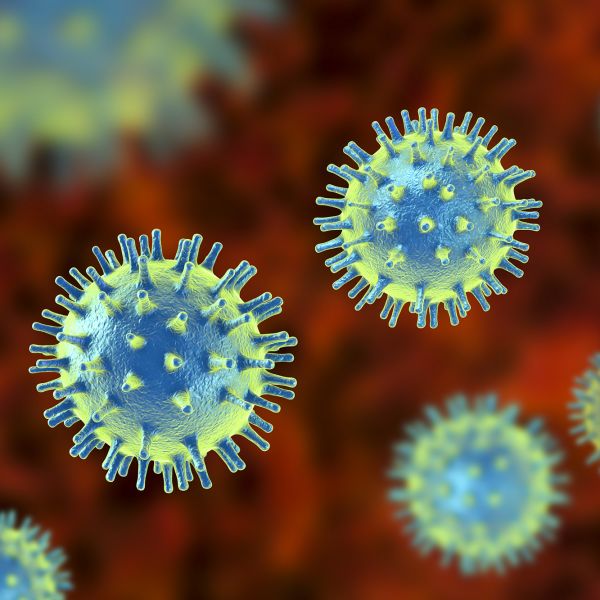
They don’t breathe. They don’t think. They aren’t even alive and they can reshape entire populations.
A virus, on average, is around 100 nanometers. That’s 1000 times smaller than a single strand of hair. In fact, thousands of them lined up would barely be the size of the tip of a pencil.
And, the worst part is they can hijack your body with ease.
These tiny microbes start their mornings hanging out in the air. Not doing anything fancy – no creation of Adenosine Triphosphate, no ribosomes endlessly synthesising proteins, no negative feedback loops maintaining homeostasis- they’re simply chilling.
Until midday, when their luck strikes. The virus encounters a host cell. Their proteins bind on to those of our cells, allowing them to deliver viral genetic material into the cell.
By afternoon, the virus initiates a process that is both simple and highly effective. Its genetic material is read by the host’s cellular machinery. Ribosomes begin translating viral instructions, producing viral proteins. Enzymes replicate the viral genome. The cell’s energy reserves are redirected toward assembling new viral components.
The host cell, designed to sustain life, is now repurposed into a production system. Within hours, the cell may contain hundreds or thousands of new viral particles.
And as evening approaches, the host cell reaches its limit. The cell undergoes lysis: rupturing and releasing viral particles into the surrounding environment. The newly formed viruses disperse, each capable of repeating the same process in neighbouring cells. What began as a single interaction rapidly expands into widespread infection.
By midnight, cells begin to signal distress, releasing chemical messengers that activate the immune system. Innate immune responses attempt to limit the spread, while adaptive responses begin to identify and target the virus more specifically.
Antibodies bind to viral particles. Immune cells destroy infected cells. Inflammation and fever emerge as systemic responses.
From a biological perspective, these are defensive mechanisms.
From the perspective of the virus, they are constraints.
The outcome of this interaction depends on multiple factors: the speed of viral replication, the strength of the immune response, and the ability of the virus to persist within the host.
Its outcome? The difference between a contained infection and a global crisis.
Lauer, A. “Viruses, Underestimated Drivers of Ecology and Evolution of Life.” Microbes: The Foundation Stone of the Biosphere, edited by C. J. Hurst, Springer, 2016.
Lwoff, André. The Concept of Virus. Journal of General Microbiology, vol. 17, no. 2, 1957, pp. 239–253.
https://link.springer.com/chapter/10.1007/978-3-319-07758-1_2
Rayport, Jeffrey F. The Virus of Marketing. Harvard Business School Publishing, 1996.
https://frederikhermann.com/uploads/rayport_the_virus_of_marketing.pdf




Leave a Reply