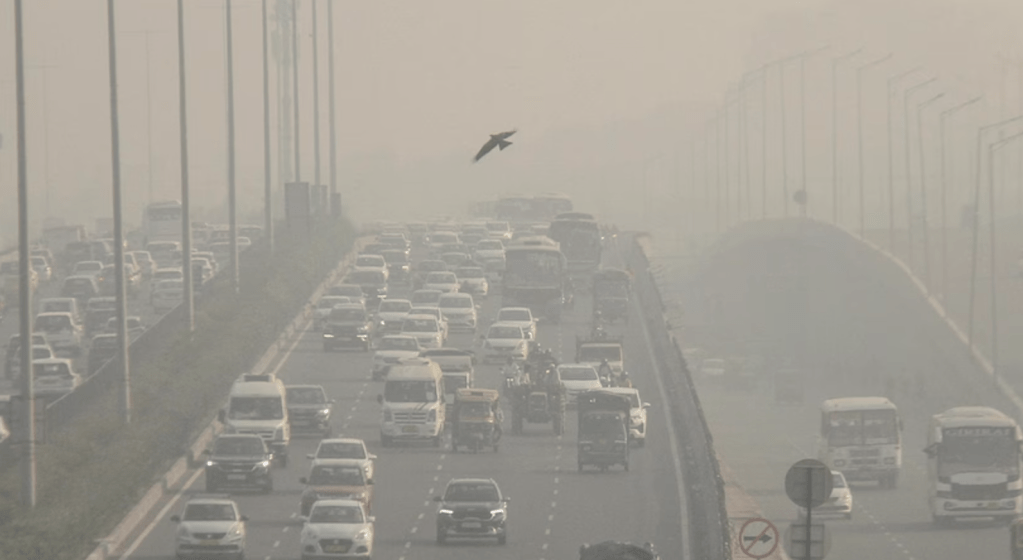
As the weather gets colder, the people of New Delhi, the capital of India, brace themselves as a ‘burial shroud’ of smog descends over the city and transforms it into a palpable gas chamber. Being a yearly occurrence, one would think that something would have been done to fight this annual catastrophe, right? Well, think again. The pollution problem of Delhi, and the areas surrounding the city, has only grown in recent years. Finally, this year, New Delhi has been awarded the title of the world’s most polluted city, reaching an AQI of 1,700. The toxic air has the effect of shortening lifespans and increasing the likelihood of respiratory diseases. What’s happening?
There is not one, but numerous reasons why toxic gas hangs over Delhi every year. A major issue, making up 25% of Delhi’s pollution, is traffic. There are over 7.9 million registered vehicles in Delhi, of which 90.5% are cars and two-wheelers. Most of these cars run on diesel or petrol, which pollute the environment. To reduce greenhouse gas emissions, these vehicles must be electric or follow the BS6 emission norms. But why are there so many cars in the first place? This is both a societal and an infrastructural problem. Nowadays in India, it is seen as a status symbol to own a private vehicle. But the public transport system in India is evidently inadequate to support the exponentially growing population. Many residents believe that the current metro system is poorly connected. As for the public bus system, for every one hundred thousand people in Delhi, there are only 45 buses. In 1998, the Supreme Court declared that Delhi needs to have 10,000 public buses in order to be sufficient for the population. As of July 2024, Delhi only has 7,683 buses, of which only 1,970 are electric buses. Delhi’s population has more than tripled since the Supreme Court made this declaration. As evident, there must be a drastic improvement in Delhi’s public transport system in order to see cleaner air in Delhi year-round.
Another reason for the high levels of pollution in Delhi is waste. Modern methods of managing waste such as recycling, reusing and composting are still not widely used in Delhi, and the result is the enormous amounts of waste that end up in landfills. An example of the extent of this problem is the well-known ‘mountain of garbage’ in Delhi, that rises taller than the Taj Mahal. As the amount of garbage increases by the tons, land to dump it remains limited. As a result, the waste is destroyed through burning. This releases a significant amount of greenhouse gases, as everyday in Delhi 190 to 246 tons of garbage is burned.
However, the question still remains; what happens specifically in the beginning of winter that causes the pollution levels to skyrocket to such unbelievable extremes? One of the answers is stubble burning. Stubble burning is a practice by farmers in the states of Haryana and Punjab, during late-October to November, in which farmers burn their fields in order to prepare them in the quickest and cheapest way possible during the short turnaround time they have between harvesting rice crops and planting wheat. While this practice has been made illegal since 2015, it still continues as the law is largely unenforced. The polluting smoke from these fires is carried by the wind over to Delhi, where it resides, forming a thick cloud of smog. Not only does this practice contribute a major part of Delhi’s yearly pollution crisis, endangering millions of people’s lives, but it also reduces the fertility of the soil itself, as the high temperatures kill necessary microorganisms in the soil. This, in the end, disadvantages the farmers as well. This practice needs to be stopped in order to end Delhi’s annual pollution catastrophe.
As you have seen, Delhi’s pollution crisis is only growing and cannot remain unaddressed any longer. Permanent solutions that address the roots of the numerous problems are necessary in order for the residents of Delhi and its surrounding areas to be finally able dispel the dread that comes every year with the beginning of winter, and to finally gain access to a basic human necessity; clean air to breathe.
- https://www.theguardian.com/world/2024/nov/22/the-air-is-killing-us-why-delhi-india-pollution-problem-runs-deeper-than-smog-season
- https://www.youtube.com/watch?v=LK8dlWwmn3g
- https://www.indiatoday.in/cities/delhi/story/delhis-10000-bus-goal-still-unmet-vehicles-drive-citys-pollution-ngo-data-2629973-2024-11-08
- https://www.macrotrends.net/global-metrics/cities/21228/delhi/population
- https://www.ndtv.com/india-news/indias-tallest-rubbish-mountain-in-delhis-ghazipur-may-rise-higher-than-taj-mahal-2047618



 The Curious Gene Blog
Leave a comment