
Imagine singing along to your favourite song. No, you’re not streaming it from Spotify or Apple Music or even Youtube – you are hearing it straight from someone else’s thoughts. Scientists at Berkeley have accomplished just that, offering a new way to listen to the human mind!
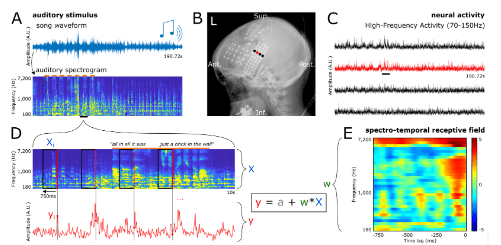
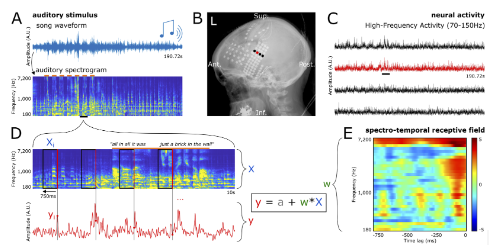
In this groundbreaking study published in August 2023, scientists have reconstructed the infamous Pink Floyd song, “Another Brick in the Wall” (part 1) solely using brainwave data. Researchers recorded the brain activity of 29 epilepsy patients at the Albany Medical Center while they listened to the song. Doctors placed electrodes in their brains to monitor electrical activity and captured their natural responses using iEEG (intracranial electroencephalography). They focused on the areas of the brain that are involved in music perception which differs from that of speech.

Fig. 1: Showing comparison between original song and reproduced version along with x-ray scan showing position of electrodes and signals.
The result? A muffled but recognizable rendition of the iconic song. Made possible by the use of an advanced computational model, the researchers managed to achieve an incredible accuracy of 42.9 percent. The computer model matched brain activity patterns with musical elements such as rhythm and melody to produce an audio of the song which seemed like it was played under water. Fuzzy yet identifiable.
Don’t believe it? Here’s an audio of the reconstructed brainwaves. https://drive.google.com/file/d/13XQODyLcBschTfIPccJo6nXWo6WIA66Z/view?usp=sharing
The data also reinforced the understanding that different parts of the brain are involved in the processing of music and speech. While speech utilises the left hemisphere of the brain, music uses both, primarily the right.
The application of this outstanding research goes further than reading your friend’s mind. This paves the way for people with neurological disorders or speech impairments to communicate in a more natural way with intonation and variation. This study involved invasive procedures with the electrode implants but it’s not long before non-invasive methods will be employed. This breakthrough offers a glimpse of hope for future technologies that could bridge the gap between our minds and the world around us.
Citations:
Bellier, Ludovic, et al. “Music Can Be Reconstructed From Human Auditory Cortex Activity Using Nonlinear Decoding Models.” PLoS Biology, vol. 21, no. 8, Aug. 2023, p. e3002176. https://doi.org/10.1371/journal.pbio.3002176.
Jacobs, Phie. “Hear a classic Pink Floyd song reconstructed from listeners’ brain waves.” science.org, 15 August 2023, Hear a classic Pink Floyd song reconstructed from listeners’ brain waves. Accessed 25 August 2024.
Kiros, Hana. “Scientists Recreate Pink Floyd Song by Reading Brain Signals of Listeners (Published 2023).” The New York Times, 30 August 2023, https://www.nytimes.com/2023/08/15/science/music-brain-pink-floyd.html. Accessed 25 August 2024.
Lanese, Nicoletta. “18 Brain Studies That Blew Our Minds in 2023.” livescience.com, 22 Dec. 2023, http://www.livescience.com/health/neuroscience/18-brain-studies-that-blew-our-minds-in-2023.


 The Curious Gene Blog
Leave a comment